


1. 前言
《手册》 第 11-12 页 对 ArrayList 的 subList 和 Arrays.asList() 进行了如下描述 1:
【强制】ArrayList 的 subList 结果不可强转成 ArrayList,否则会抛出 ClassCastException 异 常,即 java.util.RandomAccessSubList cannot be cast to java.util.ArrayList。
【强制】在 SubList 场景中,高度注意对原集合元素的增加或删除,均会导致子列表的遍历、增加、删除产生 ConcurrentModificationException 异常。
【强制】使用工具类 Arrays.asList () 把数组转换成集合时,不能使用其修改集合相关的方法,它的 add/remove/clear 方法会抛出 UnsupportedOperationException 异常。
那么我们思考下面几个问题:
- 《手册》为什么要这么规定?
- 这对我们编码又有什么启发呢?
这些都是本节重点解答的问题。
2. 问题分析
通过前面章节的学习,相信很多人已经对通过使用类图、阅读源码和源码的注释等来学习方法已经轻车熟路了。
下面我们根据本节话题继续实战。
2.1 ArrayList 的 subList 分析
2.1.1 类图法
通过 IDEA 的提供的类图工具,我们可以查看该类的继承体系。
具体步骤:在 SubList 类中 右键,选择 “Diagrams” -> “Show Diagram” 。
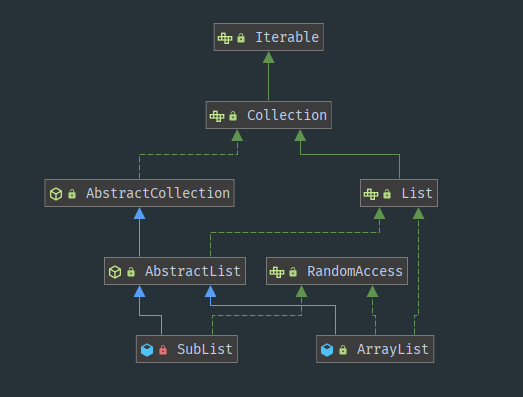
可以看到 SubList 和 ArrayList 的继承体系非常类似,都实现了 RandomAccess 接口 继承自 AbstarctList。
SubList 和 ArrayList 并没有继承关系,因此 “ ArrayList 的 SubList 并不能强转为 ArrayList 。
通过类图我们对 SubList 有了一个整体的了解,这将为我们进步学习打下很好的基础。
2.2.2 DEMO 和调试大法
如果想学习某个特性,最好的方法之一就是写一个小段 DEMO 来观察分析。
因此我们下面,写一个简单的测试代码片段来验证转换异常问题:
@Test(expected = ClassCastException.class)
public void testClassCast() {
    List<Integer> integerList = new ArrayList<>();
    integerList.add(0);
    integerList.add(1);
    integerList.add(2);
    List<Integer> subList = integerList.subList(0, 1);

    // 强转
    ArrayList<Integer> cast = (ArrayList<Integer>) subList;
}
我们还可以使用调试的表达式功能来验证我们的想法。
在调试界面的 “Variables” 窗口选择想研究的对象,如 subList ,然后右键选择 “Evaluate Expression”,输入想查执行的表达式,查看结果:
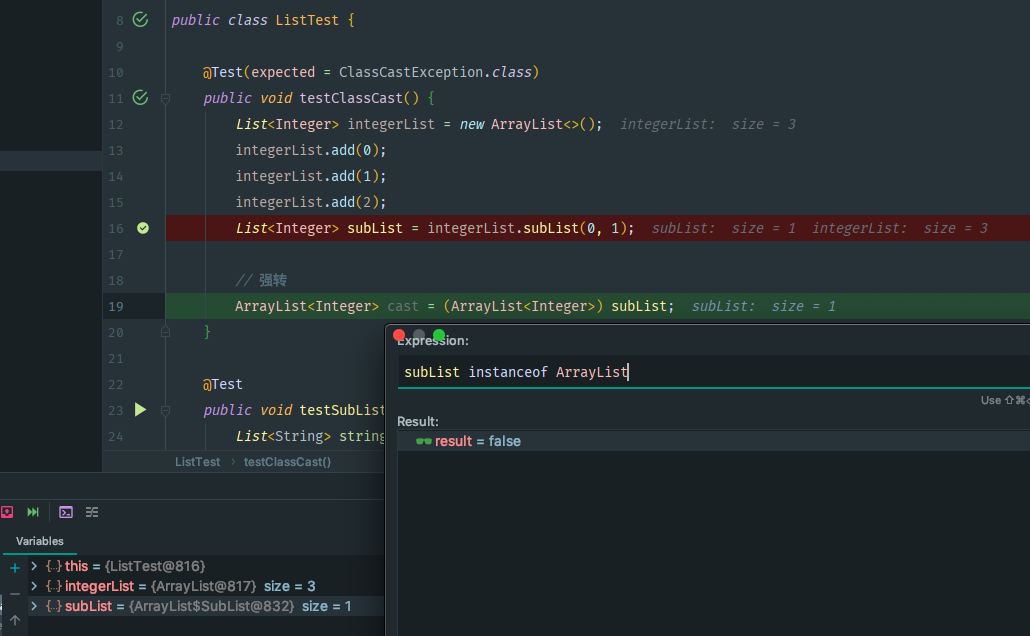
从上面的表达式的结果也可以清晰地看出,subList 并不是 ArrayList 类型的实例。
我们写一个代码片段来验证功能:
@Test
public void testSubList() {
        List<String> stringList = new ArrayList<>();
        stringList.add("赵");
        stringList.add("钱");
        stringList.add("孙");
        stringList.add("李");
        stringList.add("周");
        stringList.add("吴");
        stringList.add("郑");
        stringList.add("王");

        List<String> subList = stringList.subList(2, 4);
        System.out.println("子列表:" + subList.toString());
        System.out.println("子列表长度:" + subList.size());

        subList.set(1, "慕容");
        System.out.println("子列表:" + subList.toString());
        System.out.println("原始列表:" + stringList.toString());
 }
输出结果为:
子列表:[孙,李]
子列表长度:2
子列表:[孙,慕容]
原始列表:[赵,钱,孙,慕容,周,吴,郑,王]
可以观察到,对子列表的修改最终对原始列表产生了影响。
那么为啥修改子序列的索引为 1 的值影响的是原始列表的第 4 个元素呢?后面将进行分析和解读。
2.1.3 源码分析
java.util.ArrayList#subList 源码:
/**
 * Returns a view of the portion of this list between the specified
 * {@code fromIndex}, inclusive, and {@code toIndex}, exclusive.  (If
 * {@code fromIndex} and {@code toIndex} are equal, the returned list is
 * empty.)  The returned list is backed by this list, so non-structural
 * changes in the returned list are reflected in this list, and vice-versa.
 * The returned list supports all of the optional list operations.
 *
 * <p>This method eliminates the need for explicit range operations (of
 * the sort that commonly exist for arrays).  Any operation that expects
 * a list can be used as a range operation by passing a subList view
 * instead of a whole list.  For example, the following idiom
 * removes a range of elements from a list:
 * <pre>
 *      list.subList(from, to).clear();
 * </pre>
 * Similar idioms may be constructed for {@link #indexOf(Object)} and
 * {@link #lastIndexOf(Object)}, and all of the algorithms in the
 * {@link Collections} class can be applied to a subList.
 *
 * <p>The semantics of the list returned by this method become undefined if
 * the backing list (i.e., this list) is <i>structurally modified</i> in
 * any way other than via the returned list.  (Structural modifications are
 * those that change the size of this list, or otherwise perturb it in such
 * a fashion that iterations in progress may yield incorrect results.)
 *
 * @throws IndexOutOfBoundsException {@inheritDoc}
 * @throws IllegalArgumentException {@inheritDoc}
 */
public List<E> subList(int fromIndex, int toIndex) {
    subListRangeCheck(fromIndex, toIndex, size);
    return new SubList(this, 0, fromIndex, toIndex);
}
通过源码可以看到该方法主要有两个核心逻辑:一个是检查索引的范围,一个是构造子列表对象。
通注释我们可以学到核心知识点:
该方法返回本列表中 fromIndex (包含)和 toIndex (不包含)之间的元素视图。如果两个索引相等会返回一个空列表。
如果需要对 list 的某个范围的元素进行操作,可以用 subList,如:
list.subList(from, to).clear();
任何对子列表的操作最终都会反映到原列表中。
我们查看函数 java.util.ArrayList.SubList#set 源码:
public E set(int index, E e) {
    rangeCheck(index);
    checkForComodification();
    E oldValue = ArrayList.this.elementData(offset + index);
    ArrayList.this.elementData[offset + index] = e;
    return oldValue;
}
可以看到替换值的时候,获取索引是通过 offset + index 计算得来的。
这里的 java.util.ArrayList#elementData 即为原始列表存储元素的数组。
SubList(AbstractList<E> parent,
        int offset, int fromIndex, int toIndex) {
    this.parent = parent;
    this.parentOffset = fromIndex;
    this.offset = offset + fromIndex;
    this.size = toIndex - fromIndex;
    this.modCount = ArrayList.this.modCount; // 注意:此处复制了 ArrayList的 modCount
}
通过子列表的构造函数我们知道,这里的偏移量 ( offset ) 的值为 fromIndex 参数。
因此上小节提到的:** 为啥子序列的索引为 1 的值影响的是原始列表的第 4 个元素呢?** 的问题就不言自明了。
另外在 SubList 的构造函数中,会将 ArrayList 的 modCount 赋值给 SubList 的 modCount 。
我们再回到规约中规定:
【强制】在 subList 场景中,高度注意对原集合元素的增加或删除,均会导致子列表的遍历、增加、删除产生 ConcurrentModificationException 异常。
我们看 java.util.ArrayList#add(E) 的源码:
/**
 * Appends the specified element to the end of this list.
 *
 * @param e element to be appended to this list
 * @return <tt>true</tt> (as specified by {@link Collection#add})
 */
public boolean add(E e) {
    ensureCapacityInternal(size + 1);  // Increments modCount!!
    elementData[size++] = e;
    return true;
}
可以发现新增元素和删除元素,都会对 modCount 进行修改。
我们再看 SubList 的 核心的函数,如 java.util.ArrayList.SubList#get 和 java.util.ArrayList.SubList#size :
public E get(int index) {
    rangeCheck(index);
    checkForComodification();
    return ArrayList.this.elementData(offset + index);
}

public int size() {
    checkForComodification();
    return this.size;
}
都会进行修改检查:
java.util.ArrayList.SubList#checkForComodification
private void checkForComodification() {
    if (ArrayList.this.modCount != this.modCount)
        throw new ConcurrentModificationException();
}
而从上面的 SubList 的构造函数我们可以看到,SubList 复制了 ArrayList 的 modCount,因此对原函数的新增或删除都会导致 ArrayList 的 modCount 的变化。而子列表的遍历、增加、删除时又会检查创建 SubList 时的 modCount 是否一致,显然此时两者会不一致,导致抛出 ConcurrentModificationException (并发修改异常)。
至此上面约定的原因我们也非常明了了。
2.2 Arrays.asList () 分析
2.2.1 类图法
和前面一样,查看类图来了解 Arrays.asList() 的返回类型。
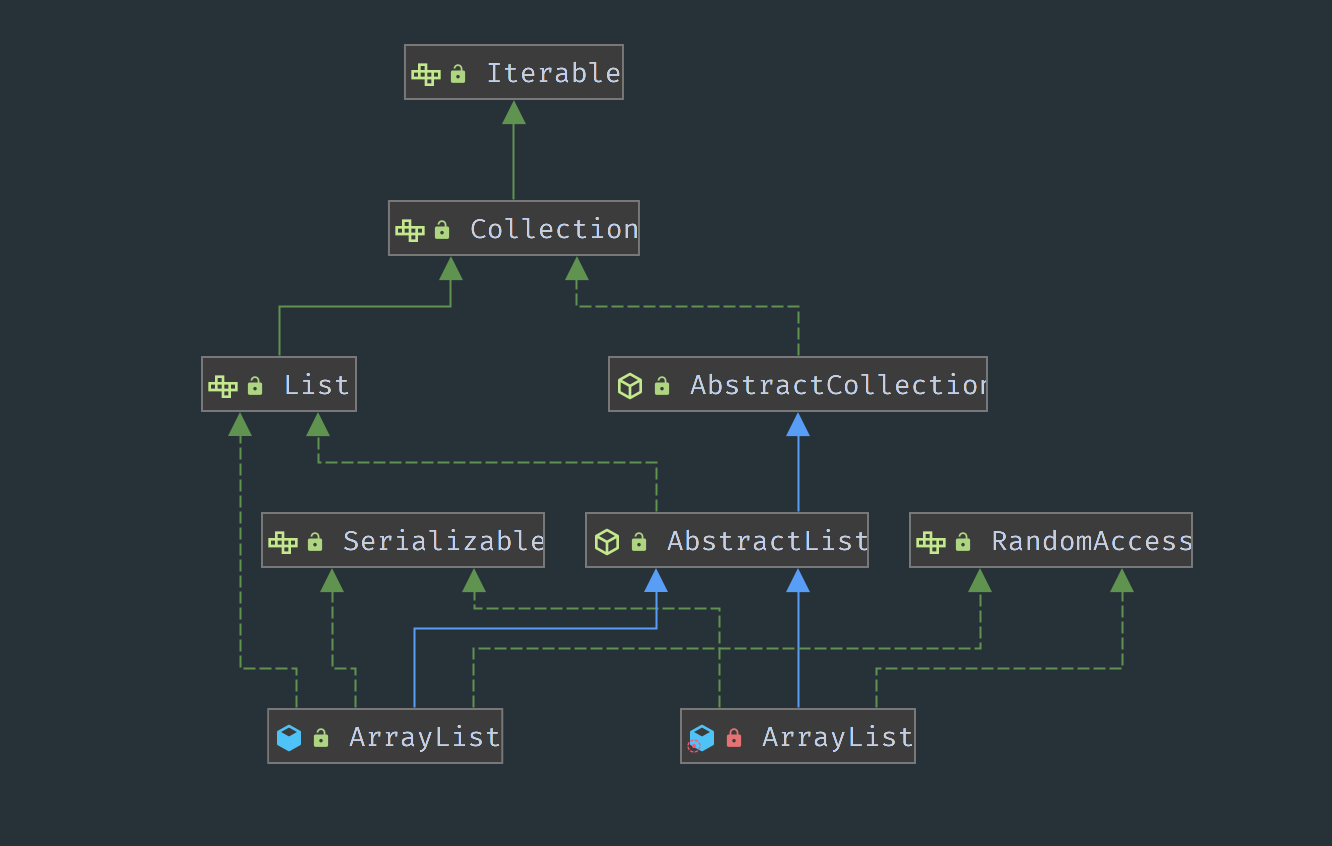
发现该 java.util.Arrays.ArrayList (右侧) 和 java.util.ArrayList (左侧),的继承体系非常相似,继承自 java.util.AbstractList 。
我们打开左上角的 “Method” 功能,对比两者的主要函数的异同:
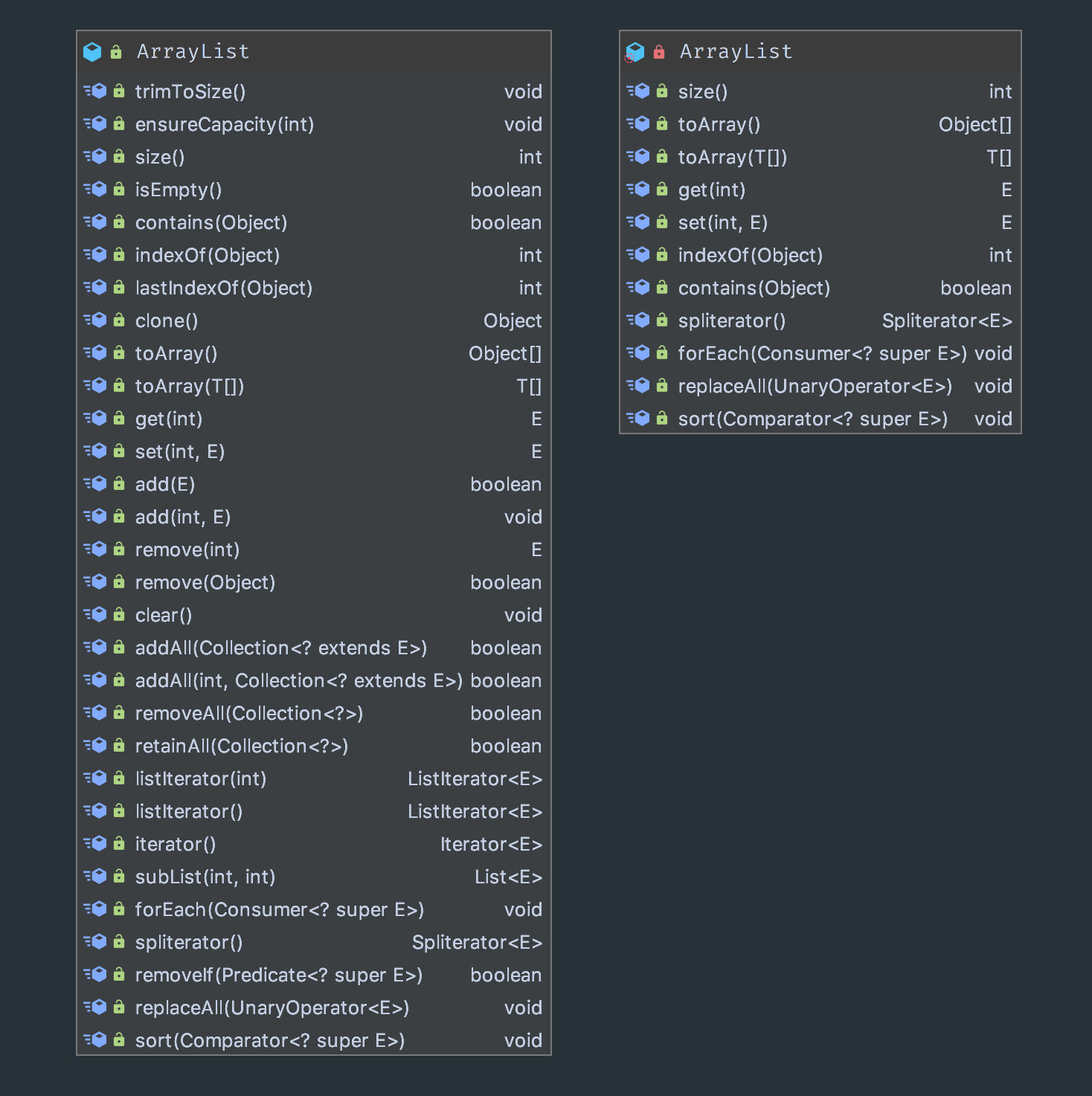
我们可以清楚地发现, java.util.Arrays.ArrayList (右侧) 并没有像左侧一样 重写 add 、 remove 函数。
2.2.2 源码大法
接下来我们分析 Arrays.asList() 的源码:
/**
* Returns a fixed-size list backed by the specified array. (Changes to
* the returned list "write through" to the array.) This method acts
* as bridge between array-based and collection-based APIs, in
* combination with {@link Collection#toArray}. The returned list is
* serializable and implements {@link RandomAccess}.
*
* <p>This method also provides a convenient way to create a fixed-size
* list initialized to contain several elements:
* <pre>
* List<String> stooges = Arrays.asList("Larry", "Moe", "Curly");
* </pre>
*
* @param <T> the class of the objects in the array
* @param a the array by which the list will be backed
* @return a list view of the specified array
*/
@SafeVarargs
@SuppressWarnings("varargs")
public static <T> List<T> asList(T... a) {
return new ArrayList<>(a);
}
通过注释我们可以得到下面的要点:
返回基于特定数组的定长列表。
该方法扮演数组到集合的桥梁。
该方法也提供了包含多个元素的定长列表的方法:
List stooges = Arrays.asList(“Larry”, “Moe”, “Curly”);
可看出此方法的功能是为了返回定长的列表。
这里的” 定长列表 “的描述非常重要,这也就解释了为什么不支持增加和删除元素的原因。
结合前面的类图,我们去查看 AbstactList 的 add 和 remove 相关函数:
java.util.AbstractList#add(int, E)
public void add(int index, E element) {
    throw new UnsupportedOperationException();
}
java.util.AbstractList#remove
public E remove(int index) {
    throw new UnsupportedOperationException();
}
可知如果子类不重写这两个函数,就会抛出 UnsupportedOperationException(不支持的操作异常)。
我们再看看 java.util.AbstractList#clear 的源码:
/**
 * Removes all of the elements from this list (optional operation).
 * The list will be empty after this call returns.
 *
 * <p>This implementation calls {@code removeRange(0, size())}.
 *
 * <p>Note that this implementation throws an
 * {@code UnsupportedOperationException} unless {@code remove(int
 * index)} or {@code removeRange(int fromIndex, int toIndex)} is
 * overridden.
 *
 * @throws UnsupportedOperationException if the {@code clear} operation
 *         is not supported by this list
 */
public void clear() {
    removeRange(0, size());
}
通过注释可知 如果没有重写 remove(int index) 或 removeRange(int fromIndex, int toIndex) 同样也会抛出 UnsupportedOperationException 。
3. 学习的启发
在 Java 的学习过程中,大多数人都是通过看视频,读博客,搜索引擎搜索,买书等来学习知识。
但是很多资料都是告诉你结论,但这样容易浮于表面,知其然而不知其所以然。而源码、官方文档等才是权威的知识。
希望从现在开始学习和开发中能够偶尔到感兴趣的类中查看源码,这样学的更快,更扎实。通过进入源码中自主研究,这样印象更加深刻,掌握的程度更深。
我们同样发现学习的手段并非只有一种,往往多种研究方式结合起来效果最好。
4. 总结
本文通过类图分析、源码分析以及 DEMO 和调试的方式对 ArrayList 的 SubList 问题和 Arrays 的 asList 进行分析。并根据分析阐述了对我们学习的启发。
本节的要点:
ArrayList内部类SubList和ArrayList没有继承关系,因此无法将其强转为ArrayList。ArrayList的SubList构造时传入ArrayList的modCount,因此对原列表的修改将会导致子列表的遍历、增加、删除产生 ConcurrentModificationException 异常。Arrays.asList()函数是提供通过数组构造定长集合的功能,该函数提供数组到集合的桥梁。
下一节我们将讲述添加注释的正确姿势。
5. 课后练习
《手册》第 11 页 集合处理章节有这么一条规定:
【强制】不要在 foreach 循环里进行元素的 remove/add 操作。remove 元素请使用 Iterator 方式,如果并发操作,需要对 Iterator 对象加锁。
那么问题来了,为什么 “不要在 foreach 循环里进行元素的 remove/add 操作。remove 元素请使用 Iterator 方式”?
请大家结合前面和本小节所学的内容自己实际动手研究一下。
