


1. 前言
《手册》的第 11 页 关于集合处理的章节有这样的描述 1:
【参考】利用 Set 元素唯一的特性,可以快速对一个集合进行去重操作,避免使用 List 的 contains 方法进行遍历、对比、去重操作。
【强制】关于 hashCode 和 equals 的处理,遵循如下规则:
- 只要覆写 equals,就必须覆写 hashCode;
- 因为 Set 存储的是不重复的对象,依据 hashCode 和 equals 进行判断,所以 Set 存储的对象必须覆写这两个方法;
- 如果自定义对象作为 Map 的键,那么必须覆写 hashCode 和 equals。
说明:String 已覆写 hashCode 和 equals 方法,所以我们可以愉快地使用 String 对象作为 key 来使用。
可能很多人会认为工作之后不会有人通过 List 的 contains 函数来去重,然而,最可怕的是真的有…
那么我们思考下面几个问题:
- Set 是怎样保证数据的唯一性呢?
- Set 存储的是不重复的对象,是不是根据 hashCode 和 equals 来判断是否重复的呢?
- Set 和 List 的去重性能差距是多大呢?
本节将重点研究这几个问题。
2. 唯一性保证
开发中常见到使用 Set 去重的代码如下:
public static <T> Set<T> removeDuplicateBySet(List<T> data) {

    if (CollectionUtils.isEmpty(data)) {
        return new HashSet<>();
    }
    return new HashSet<>(data);
}
注:Set 自身可以保证不重复,不需要先通过 contains 判断不存在再添加元素。
我们先看 java.util.HashSet 的类注释 (注释内容省略,具体请大家看源码)中的一些要点:
实现了
Set接口。基于
HashMap来实现核心功能。允许存入
null元素,不保证顺序。该类的方法并没同步,如果想要同步需要外部处理,可以构造一个同步对象,也可以使用
Collections#synchronizedSet, 最佳实践:
Set s = Collections.synchronizedSet(new HashSet(...));迭代方法返回的迭代器是 “fail-fast” 的,迭代器创建后如果调用除了迭代器自己的
remove函数外的其他修改方法,会抛出:ConcurrentModificationException。
我们再看看 HashSet 对应的构造函数 java.util.HashSet#HashSet(java.util.Collection<? extends E>) 源码:
/**
 * Constructs a new set containing the elements in the specified
 * collection.  The <tt>HashMap</tt> is created with default load factor
 * (0.75) and an initial capacity sufficient to contain the elements in
 * the specified collection.
 *
 * @param c the collection whose elements are to be placed into this set
 * @throws NullPointerException if the specified collection is null
 */
public HashSet(Collection<? extends E> c) {
    map = new HashMap<>(Math.max((int) (c.size()/.75f) + 1, 16));
    addAll(c);
}
从这里我们看到了底层的确是通过 HashMap 支持的,根据参数集合的长度构造对应默认容量的 HashMap。
然后调用父类的 java.util.AbstractCollection#addAll (添加所有元素的函数):
  public boolean addAll(Collection<? extends E> c) {
        boolean modified = false;
        for (E e : c)
            if (add(e))
                modified = true;
        return modified;
    }
从这里可以看出,通过 for-each 语法糖对集合进行迭代并调用 add 函数将元素依次添加到 HashSet 中。
// Dummy value to associate with an Object in the backing Map
private static final Object PRESENT = new Object();
/**
* Adds the specified element to this set if it is not already present.
* More formally, adds the specified element <tt>e</tt> to this set if
* this set contains no element <tt>e2</tt> such that
* <tt>(e==null ? e2==null : e.equals(e2))</tt>.
* If this set already contains the element, the call leaves the set
* unchanged and returns <tt>false</tt>.
*
* @param e element to be added to this set
* @return <tt>true</tt> if this set did not already contain the specified
* element
*/
public boolean add(E e) {
return map.put(e, PRESENT)==null;
}
通过这个函数的注释,我们可以看到:
该函数的功能是添加 set 中没添加过的元素。
更准确地说,如果想将元素 e 添加到此集合中,那么集合中不能存在元素 e2 满足:
( e== null ? e2 ==null : e.equals(e2) ) 。
如果已经包含了该元素,那么集合将不会发生改变,将返回 false。
从这里我们还看到,为了保持 HashMap 的用法,这里给底层的 Map 的值传入一个傀儡对象(PRESENT)。
我们进入更底层源码 java.util.HashMap#put :
public V put(K key, V value) {
    return putVal(hash(key), key, value, false, true);
}
通过这里我们看到,除了传入 key 和 value 外,第一个哈希值的参数 (hash) 是通过 HashMap 的 hash 函数实现的。
static final int hash(Object key) {
    int h;
    return (key == null) ? 0 : (h = key.hashCode()) ^ (h >>> 16);
}
可以看到如果 key 为 null ,哈希值为 0,否则将 key 通过自身 hashCode 函数计算的的哈希值和其右移 16 位进行异或运算得到最终的哈希值。
在 java.util.HashMap#putVal 中,直接通过 (n - 1) & hash 来得到当前元素在节点数组中的位置。如果不存在,直接构造新节点并存储到该节点数组的对应位置。如果存在,则通过下面逻辑:
p.hash == hash && ((k = p.key) == key || (key != null && key.equals(k)))
来判断元素是否相等。
如果相等则用新值替换旧值,否则添加红黑树节点或者链表节点。
这就是前言中第 2 和第 3 条规定的依据。
最终如果存在 key 则返回旧值,不存在则返回 null。
此时,我们再回看 java.util.HashSet#add 源码:
public boolean add(E e) {
    return map.put(e, PRESENT)==null;
}
一切就非常清晰了。
通过 HashMap 的 key 的唯一性保证 HashSet 的元素的唯一性。
我们再看 HashSet 的迭代器 java.util.HashSet#iterator:
 /**
     * Returns an iterator over the elements in this set.  The elements
     * are returned in no particular order.
     *
     * @return an Iterator over the elements in this set
     * @see ConcurrentModificationException
     */
    public Iterator<E> iterator() {
        return map.keySet().iterator();
    }
我们发现,其实 HashSet 的元素是存放在 HashMap 的 keySet 中。
大家可以进入 HashSet 的其他方法中查看,可以发现几乎 HashSet 的所有核心函数都是通过 HashMap 支撑的。
由于 HashSet 底层采用 HashMap 实现,通过上述分析,我们可知其 “去重” 的时间复杂度是 O (n)。
另外我们回答前言中 “关于 hashCode 和 equals 的处理” 的第 1 条:** 只要覆写 equals,就必须覆写 hashCode”。** 这个问题。
除了上面讲到的判断重复的依据外,从其源码 java.lang.Object#equals 的注释中也可以得到更本质的原因:
Note that it is generally necessary to override the {@code hashCode} method whenever this method is overridden, so as to maintain the general contract for the {@code hashCode} method, which states that equal objects must have equal hash codes.
只要重写 equals 方法就要重新 hashCode 方法,来维持 hashCode 的约定,即 equals 的对象的哈希值必须相等。
3. 性能差异的原因
前面讲到 “由于 HashSet 底层采用了 HashMap 实现,因此去重的时间复杂度是 O (n)”。
那么,通过 List 的 contains 函数来去重,原理又是怎样的呢?时间复杂度是多少呢?
且看下面基于 List 的 contains 函数来去重示例代码:
public static <T> List<T> removeDuplicateByList(List<T> data) {

    if (CollectionUtils.isEmpty(data)) {
        return new ArrayList<>();

    }
    List<T> result = new ArrayList<>(data.size());
    for (T current : data) {
        if (!result.contains(current)) {
            result.add(current);
        }
    }
    return result;
}
其实 HashSet 和 ArrayList 去重性能差异的核心在于 contains 函数性能对比。
我们分别查看 java.util.HashSet#contains 和 java.util.ArrayList#contains 的实现。
java.util.HashSet#contains 源码:
/**
* Returns <tt>true</tt> if this set contains the specified element.
* More formally, returns <tt>true</tt> if and only if this set
* contains an element <tt>e</tt> such that
* <tt>(o==null ? e==null : o.equals(e))</tt>.
*
* @param o element whose presence in this set is to be tested
* @return <tt>true</tt> if this set contains the specified element
*/
public boolean contains(Object o) {
return map.containsKey(o);
}
最终是通过 java.util.HashMap#getNode 来判断的(和 java.util.HashMap#putVal 的一些判断非常相似):
/**
 * Implements Map.get and related methods.
 *
 * @param hash hash for key
 * @param key the key
 * @return the node, or null if none
 */
final Node<K,V> getNode(int hash, Object key) {
    Node<K,V>[] tab; Node<K,V> first, e; int n; K k;
    if ((tab = table) != null && (n = tab.length) > 0 &&
        (first = tab[(n - 1) & hash]) != null) {
        if (first.hash == hash && // always check first node
            ((k = first.key) == key || (key != null && key.equals(k))))
            return first;
        if ((e = first.next) != null) {
            if (first instanceof TreeNode)
                return ((TreeNode<K,V>)first).getTreeNode(hash, key);
            do {
                if (e.hash == hash &&
                    ((k = e.key) == key || (key != null && key.equals(k))))
                    return e;
            } while ((e = e.next) != null);
        }
    }
    return null;
}
先通过计算过的 hash 值找到 table 对应索引的第一个元素进行比较,如果相等则返回第一个元素。
如果是树节点,从红黑树中查找该元素,否则在链表中查找该元素。
如果 hash 冲突不是极其严重(大多数都没怎么有哈希冲突),n 个元素依次判断并插入到 Set 的时间复杂度接近于 O (n)。
接下来我们看 java.util.ArrayList#contains 的源码:
/**
* Returns <tt>true</tt> if this list contains the specified element.
* More formally, returns <tt>true</tt> if and only if this list contains
* at least one element <tt>e</tt> such that
* <tt>(o==null ? e==null : o.equals(e))</tt>.
*
* @param o element whose presence in this list is to be tested
* @return <tt>true</tt> if this list contains the specified element
*/
public boolean contains(Object o) {
return indexOf(o) >= 0;
}
其功能实现依赖于 java.util.ArrayList#indexOf:
/**
* Returns the index of the first occurrence of the specified element
* in this list, or -1 if this list does not contain the element.
* More formally, returns the lowest index <tt>i</tt> such that
* <tt>(o==null ? get(i)==null : o.equals(get(i)))</tt>,
* or -1 if there is no such index.
*/
public int indexOf(Object o) {
if (o == null) {
for (int i = 0; i < size; i++)
if (elementData[i]==null)
return i;
} else {
for (int i = 0; i < size; i++)
if (o.equals(elementData[i]))
return i;
}
return -1;
}
发现其核心逻辑为:如果为 null, 则遍历整个集合判断是否有 null 元素;否则遍历整个列表,通过 o.equals(当前遍历到的元素) 判断与当前元素是否相等,相等则返回当前循环的索引。
所以, n 个元素依次通过 java.util.ArrayList#contains 判断并插入到 Set 的时间复杂度接近于 O (n^2)。
因此,通过时间复杂度的比较,性能差距就不言而喻了。
4. 性能对比
上面我们分别对性能的差异原因, 时间复杂度进行了分析。
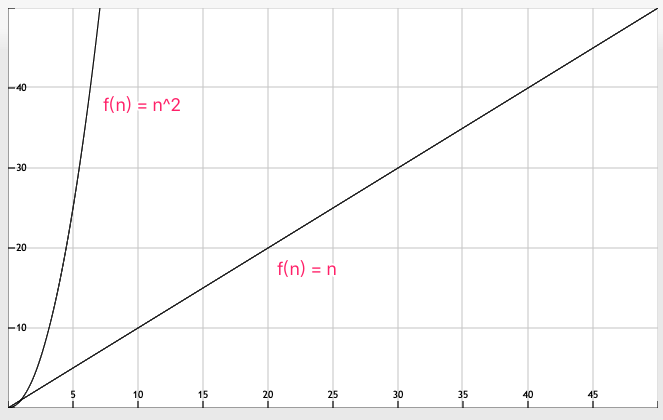
我们分别将两个时间复杂度函数进行作图, 两者增速对比非常明显:
实践是检验真理的标准,因此我们写一段代码粗略对比一下他们的性能差异:
@Slf4j
public class SetDemo {

    public static void main(String[] args) {

        List<Integer> lengthList = new LinkedList<>();
        int base = 1;
        for (int i = 1; i <= 6; i++) {
            base *= 10;
            lengthList.add(base);
        }

        StringRandomizer stringRandomizer = new StringRandomizer(10, 100, 1000);

        for (Integer length : lengthList) {
            log.debug("------------长度为 {} 时-------", length);
            ListRandomizer<String> listRandomizer = new ListRandomizer<>(stringRandomizer, length);
            List<String> data = listRandomizer.getRandomValue();

            StopWatch stopWatch = new StopWatch();
            stopWatch.start();
            Set<String> resultBySet = CollectionUtil.removeDuplicateBySet(data);
            log.debug("set去重耗时:{} ms", stopWatch.getTime());

            stopWatch = new StopWatch();
            stopWatch.start();
            List<String> resultByList = CollectionUtil.removeDuplicateByList(data);
            log.debug("list去重耗时:{} ms", stopWatch.getTime());
        }

    }
}
最终得到下面的数据:

我们重点观察最后两种情况:
长度为 10 万时使用 List 去重耗时接近 1 分钟,而使用 Set 去重则只需要 17 毫秒;
而集合长度为 100 万时,使用 List 去重,耗时则约为 1.7 小时,使用 Set 去重则只需要 1.33 秒。
对上述结果进行绘图如下:
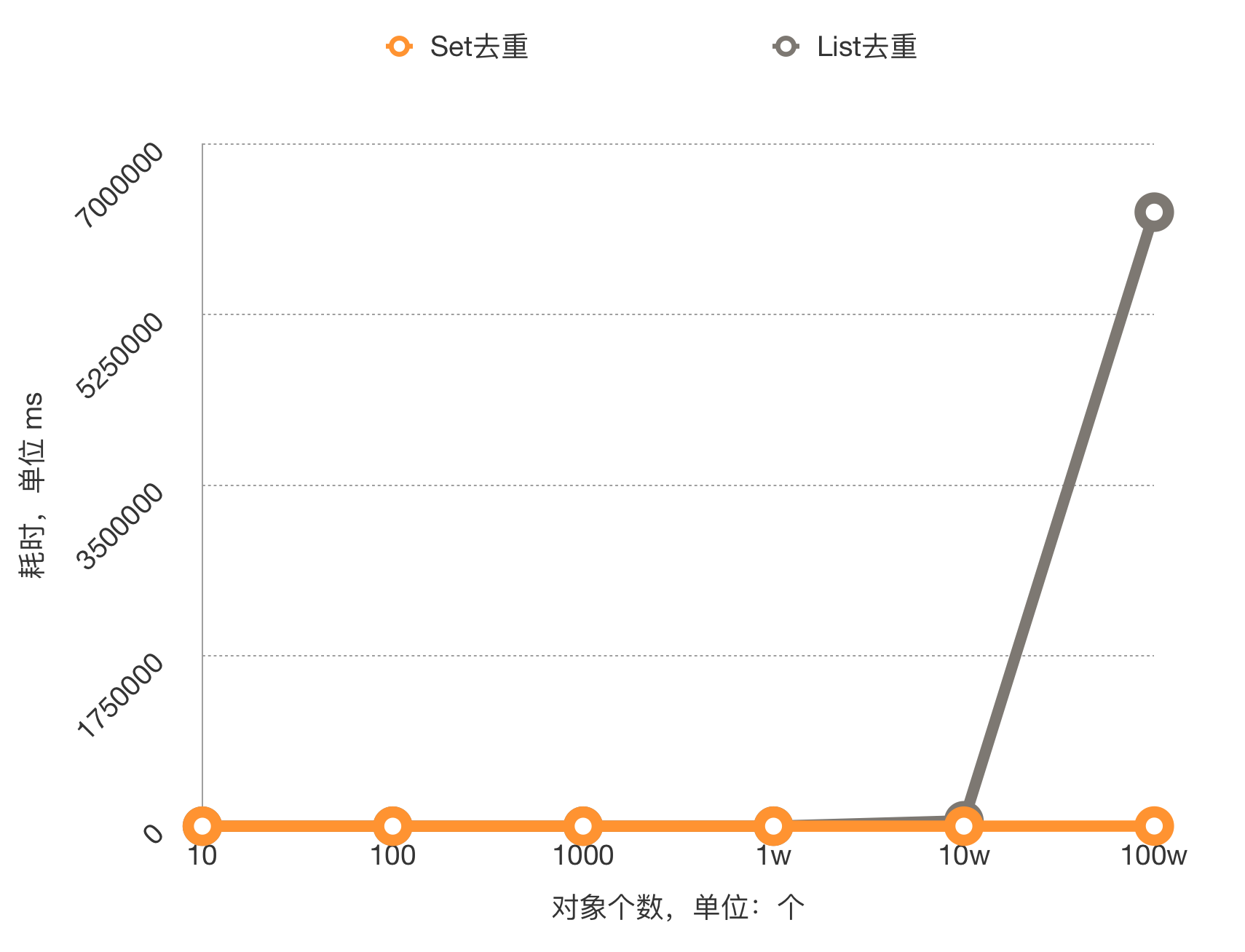
通过此图,大家就可以非常直观地感受到两种去重方式的性能差异。
我们发现当元素较少时两者耗时差距很小,随着元素的增多耗时差距越来越大。
如果数据量不大时采用 List 去重勉强可以接受,但是数据量增大后,接口响应时间会超慢,这是难以忍受的,甚至造成大量线程阻塞引发故障。
在工作中一次排查慢接口时,查到了一个函数耗时较长,最终定位到是通过 List 去重导致的。
由于测试环境还有线上早期数据较少,这个接口的性能问题没有引起较大关注,后面频繁超时,才引起重视。
因此我们要养成好的编程习惯,尽可能地提高接口性能,避免因知识盲区导致故障。
5. 为什么有人会这么用?
最后我们思考一下:为什么有人会用 List 的 contains 方法进行遍历、对比然后去重呢?
无非就是两个原因:
- 基础不扎实,不了解这种操作的时间复杂度;
- 为了维持返回值的类型。
对于第一个问题,基础不扎实我们要加强学习,多注意代码规范和代码的运行效率。
第二个问题是一种直线思维,是一种偷懒的表现。
比如某种特殊场景下需要的返回值类型为 List,“因此” 有些朋友就会声明一个 List,通过 contains 方法进行遍历、对比、去重,然后将其作为返回值返回。
其实,这种情况可以分两步走,先去重,然后通过 ArrayList 参数为集合的构造方法创建 List 对象来实现类型 “转换”,示例代码如下:
// 数据
List<String> data = listRandomizer.getRandomValue();
// 先去重
Set<String> resultBySet = CollectionUtil.removeDuplicateBySet(data);

// 再转换格式
ArrayList<String> result = new ArrayList<>(resultBySet);
6. 总结
本节主要讲述集合去重的正确姿势,主要要点有:
HashSet元素唯一性是通过HashMap的 key 唯一性来实现的;- 性能的差距是元素查找函数的时间复杂度不同导致的;
- 元素较少时两者耗时差距很小,随着元素的增多耗时差距越来越大。
下一节我们将学习如何学习线程池。
